Hard Water vs Soft Water: What It Means for Your Kitchen, Skin and Appliances
Kamal, Founder of BelieveUpdated 31 Mar 20266 min read
Quick answer
Hard water contains high levels of dissolved calcium and magnesium. India’s standard (BIS IS 10500) sets an acceptable total hardness of 200 mg/L as calcium carbonate. Hard water is not usually a health hazard to drink, but it leaves white scale on taps, utensils, kettles and geysers, makes soap lather poorly, and many people find it leaves skin and hair feeling dry. Softeners treat bathing water; RO treats drinking water.
How to tell if your water is hard
- White, chalky spots on taps, glasses and steel utensils.
- Scale inside kettles, geysers and washing machines.
- Soap and shampoo don’t lather well.
- Hair feels rough and skin feels tight after bathing.
Hardness levels at a glance
| Total hardness (mg/L CaCO₃) | Classification | What you notice |
|---|---|---|
| 0 – 60 | Soft | Easy lather; no scale |
| 60 – 120 | Moderately hard | Occasional spots |
| 120 – 180 | Hard | Visible scale on taps and kettles |
| Above 180 | Very hard | Heavy scaling; appliances suffer |
What to do about it
| Problem | Solution |
|---|---|
| Drinking water | RO purifier |
| Bathroom, hair and skin | Water softener or shower filter |
| Geyser and washing machine | Whole-house softener or regular descaling |
| Spots on glass and steel | Wipe with acidic ionizer water or diluted vinegar |
Hard water and your ionizer
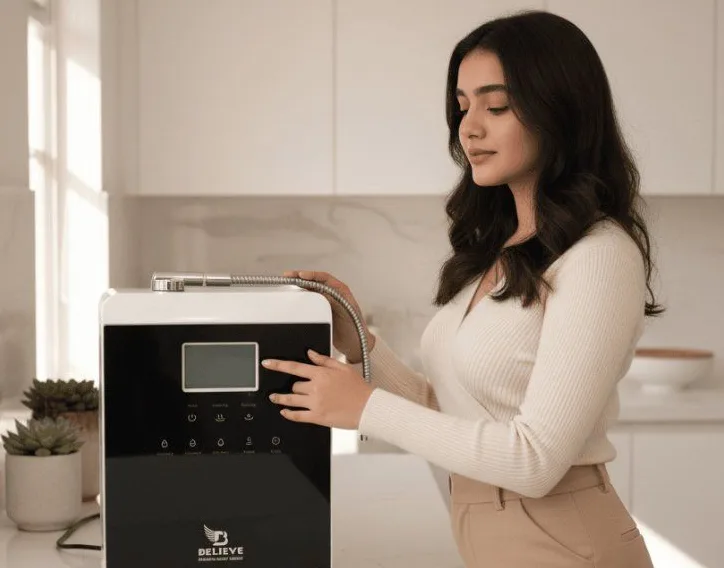
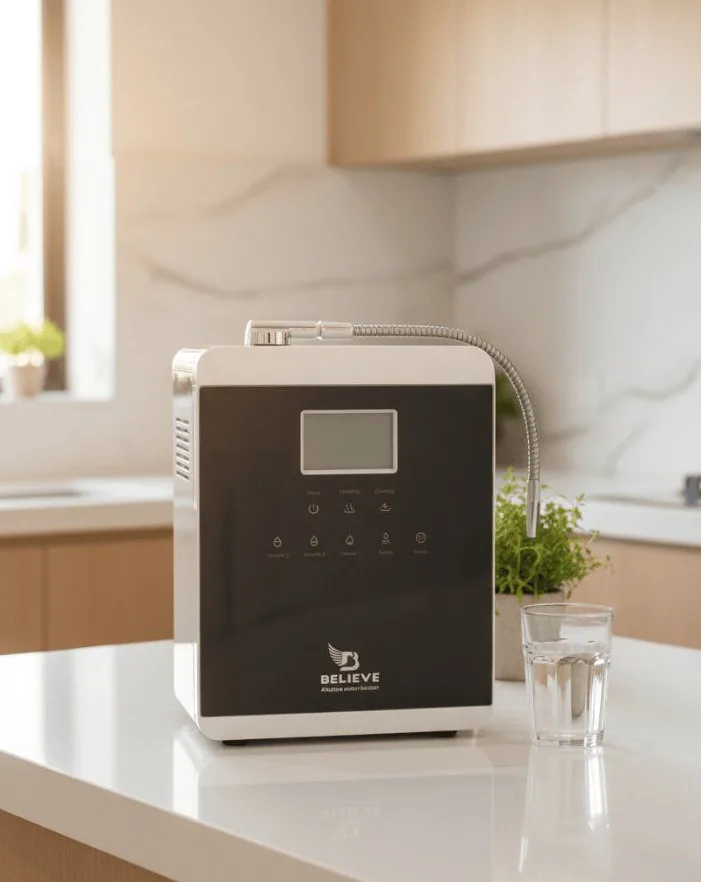
Very hard water would quickly scale the electrolysis plates in any ionizer. That is why Believe connects after an RO purifier: the RO removes most of the hardness, the ionizer’s automatic cleaning handles what is left, and the plates stay efficient for years.
Key takeaways
- Hardness = calcium and magnesium, measured as mg/L CaCO₃.
- BIS acceptable limit: 200 mg/L (permissible up to 600 mg/L).
- Softeners protect bathrooms and appliances; RO handles drinking water.
- Hard input water can scale ionizer plates, so RO comes first.
Frequently asked questions
Is hard water bad to drink?
Generally not a health hazard, and calcium and magnesium are nutrients. Very hard water tastes unpleasant and damages appliances, and it often comes with high TDS.
Will a softener make water safe to drink?
No. A softener swaps calcium and magnesium for sodium; it does not purify water. Use RO for drinking water.