Haryana’s Groundwater and TDS: Why Most Homes in Sonipat Need an RO
Kamal, Founder of BelieveUpdated 6 Jan 20267 min read
Quick answer
Central Ground Water Board reports show that many parts of Haryana have groundwater with high dissolved salts (TDS), hardness and, in some areas, fluoride or nitrate above safe limits. India’s drinking-water standard, BIS IS 10500, sets an acceptable TDS of 500 mg/L. When borewell or mixed supply water is well above that, an RO purifier is the practical way to make it safe and pleasant to drink. Test your own water: levels vary street by street.
What is TDS?
Total dissolved solids is the amount of salts and minerals dissolved in water, measured in milligrams per litre (mg/L, roughly the same as ppm). Some TDS is natural and harmless. Very high TDS makes water taste salty or bitter, leaves scale on utensils and geysers, and can indicate other problems in the water.
The Indian standard: BIS IS 10500
| Parameter | Acceptable limit | Permissible (no alternate source) |
|---|---|---|
| TDS | 500 mg/L | 2,000 mg/L |
| pH | 6.5 – 8.5 | No relaxation |
| Total hardness (as CaCO₃) | 200 mg/L | 600 mg/L |
| Fluoride | 1.0 mg/L | 1.5 mg/L |
| Nitrate | 45 mg/L | No relaxation |
What we see in Sonipat and nearby
Homes on borewells or mixed supply in and around Sonipat, Panipat and Rohtak often report TDS readings well above 500 mg/L, along with hard-water scaling. Readings change with depth, season and location, so two houses in the same sector can get very different results. That is why we test every home’s water during a demo instead of guessing.
How to test your water at home
- A digital TDS meter (a few hundred rupees) gives an instant TDS reading.
- pH drops or strips show whether water is acidic or alkaline.
- For fluoride, nitrate, arsenic or bacteria, use a NABL-accredited lab test.
- Test both your raw water and your RO output.
RO first, then improve
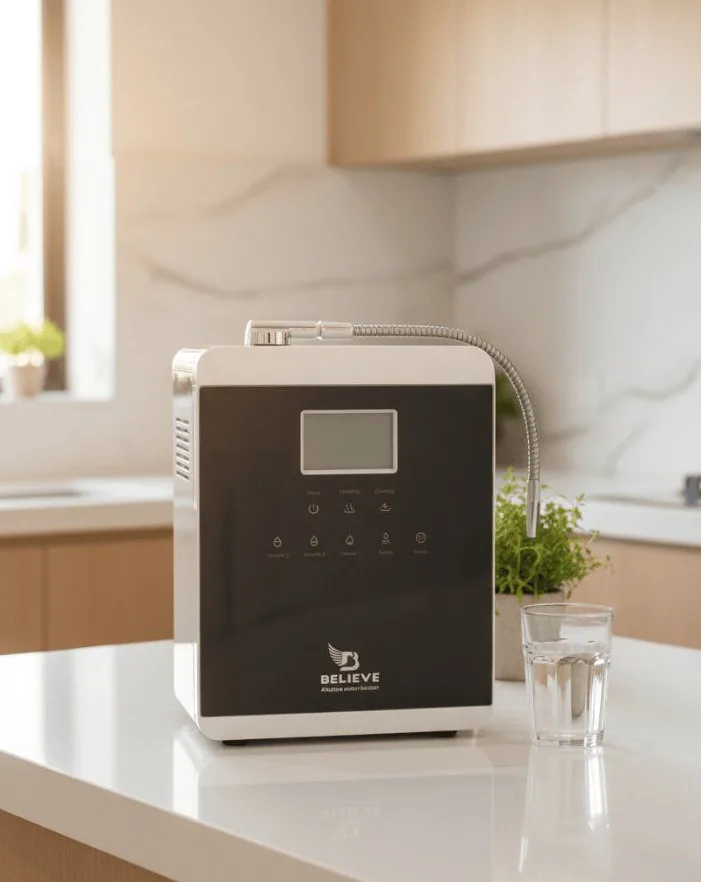
RO brings high-TDS water down to drinkable levels. The trade-off is acidic, low-mineral water. An ionizer after the RO (ideal input around 100–150 mg/L TDS) raises the pH again, adds dissolved hydrogen and gives warm water on demand. Purification first, then improvement.
Key takeaways
- BIS IS 10500: TDS acceptable limit 500 mg/L; pH 6.5–8.5.
- Groundwater quality varies a lot between neighbourhoods, even in one city.
- RO is the right tool for high-TDS water; filters alone are not enough.
- After RO, an ionizer can restore an alkaline pH and add hydrogen.
Frequently asked questions
What TDS should my RO output have?
Many households aim for roughly 50–150 mg/L for taste. For a Believe ionizer, 100–150 mg/L is ideal for efficient electrolysis.
Is very low TDS water unsafe?
Not unsafe, but it tastes flat and can be slightly acidic. Many RO units have a TDS controller to blend in some minerals.
Where can I get a full water test?
Use a NABL-accredited laboratory. Some state public health departments also offer testing.