What Is ORP? Oxidation-Reduction Potential Explained with Kitchen Examples
Kamal, Founder of BelieveUpdated 22 Dec 20256 min read
Quick answer
ORP (oxidation-reduction potential) measures, in millivolts, whether a liquid tends to take electrons from things it touches (oxidising, a positive ORP) or give electrons to them (reducing, a negative ORP). Tap and RO water typically read about +200 to +400 mV. Fresh water from an electrolysis ionizer reads negative, around −200 to −400 mV, mainly because of the dissolved hydrogen it contains. ORP describes the water’s chemistry, not a medical effect.
Oxidation in everyday life
You have seen oxidation all your life: a cut apple turning brown, an iron gate rusting, ghee going rancid. In each case, oxygen pulls electrons away from something. ORP is a way of measuring how strongly a liquid wants to do that.
Reading an ORP number
| Liquid | Typical ORP | Meaning |
|---|---|---|
| Chlorinated tap water | +400 to +600 mV | Strongly oxidising (chlorine) |
| RO water | +200 to +400 mV | Oxidising |
| Fresh ionized alkaline water | −200 to −400 mV | Reducing |
| Same water after 24 hours | Drifts back towards positive | Hydrogen has escaped |
Why ionizer water reads negative
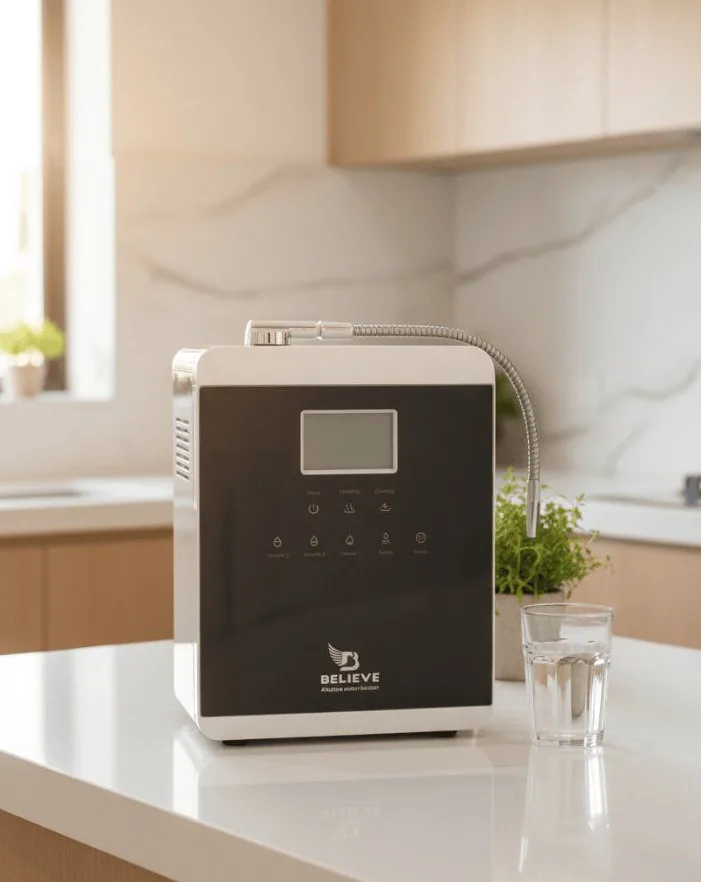
During electrolysis, the cathode (negative plate) splits water to form hydrogen gas and hydroxide ions. The dissolved hydrogen is what pushes ORP into the negative range. That is also why ORP and hydrogen readings fall together if you leave the water standing: the hydrogen slowly escapes into the air.
What ORP does, and doesn’t, tell you
- It does tell you whether the water is fresh from electrolysis and how much reducing power it has.
- It does not, by itself, prove a health benefit. Research on drinking reduced water is still limited and mostly small-scale.
- It is a useful quality check: if an ionizer’s output reads positive, something is wrong with the input water or the plates.
Measure it yourself
Inexpensive ORP pens are available online. Test your RO water, then fresh water from an ionizer, then the same water after a few hours. You will see the chemistry change in front of you. Our free home demos include exactly this test.
Key takeaways
- ORP is measured in millivolts (mV) with an ORP meter.
- Positive ORP = oxidising. Negative ORP = reducing (antioxidant tendency).
- Ionizer water gets its negative ORP mostly from dissolved hydrogen.
- Negative ORP fades over hours as hydrogen escapes, so drink it fresh.
Frequently asked questions
Is negative ORP water an antioxidant?
Chemically, negative ORP water has reducing (electron-donating) tendency. Whether that translates into health benefits in people is still being studied, so treat it as a water-quality measure, not a medical claim.
Why does my ORP reading keep changing?
ORP meters need a few minutes to settle and should be calibrated. Readings also change as hydrogen leaves the water.